
What was discovered in the desert that changed how we view the pyramids?
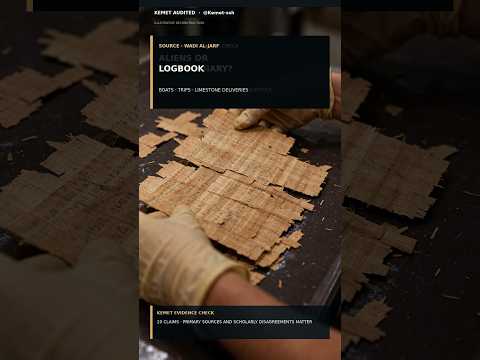
A collection of brittle papyrus fragments lay undisturbed for millennia, waiting in a desert cave to reveal the mundane, daily reality of an architectural miracle. For decades, the public imagination has been captivated by speculative theories regarding the construction of the Great Pyramid of Giza, often invoking ideas of extraterrestrial interference or supernatural labor to explain the sheer size of the structure. However, in 2013, a transformative archaeological discovery occurred. Researchers working at the remote site of Wadi el-Jarf uncovered a cache of logbooks that effectively shifted the conversation from the realm of science fiction to the realm of historical administration.
These documents, now globally recognized as the Diary of Merer, represent the oldest known written records of their kind. Because they were recovered from a physical context rather than a secondary source, they carry a unique weight in the study of Egyptology. According to Archaeology Magazine, these documents provide the first direct, contemporary account of the construction of the Great Pyramid. The discovery at Wadi el-Jarf, which is identified as the world’s oldest known artificial harbor on the Red Sea coast, serves as a cornerstone for this new understanding. By providing a tangible link between a harbor in the desert and the plateau at Giza, these papyri confirm that the pyramid was a project of immense, deliberate human organization rather than the product of non-human intervention.
The existence of these records matters because it replaces the "mystery" narrative with a "management" narrative. While popular myths have long flourished in the absence of written evidence from the time of construction, the Wadi el-Jarf find demonstrates that we must look to the state-led systems of the Old Kingdom to explain how the pharaohs mobilized their nation. The papyri do not just describe the building of a tomb; they describe the building of a state. It is important to note that the diary does not claim to solve every riddle of antiquity; rather, it highlights the importance of institutional oversight in accomplishing massive tasks. The evidence suggests that the power of the pharaonic government rested in its ability to document and track resources, providing a window into the administrative sophistication of the era.
Who was Merer and what does his diary actually say?
To understand the mechanics of the Great Pyramid, one must understand the man who documented its final years. The author of these logs was an official—an inspector—named Merer. Archaeology Magazine reports that Merer managed a crew of approximately 40 elite sailors. This designation as "elite" is important; it suggests that the workforce was not a ragtag group of unskilled laborers, but a specialized team that possessed the technical knowledge required to navigate the Nile and maneuver heavy stone. Scholars infer that these sailors were treated as a distinct class of specialized labor, given the vital nature of their transport duties.
Merer’s diary is not a poetic account of the pharaoh’s glory, but a dry, functional record of logistics. It covers several months of activity during the 27th year of the reign of Pharaoh Khufu, a period corresponding to one widely accepted scholarly estimate of 2633–2605 B.C. These entries act as a crisp, clear snapshot of the final stages of the Great Pyramid’s completion. The records specifically detail the movement of limestone blocks. These stones were not merely moved; they were sourced from the Tura quarries and transported via boat along the Nile. To facilitate this, the Egyptian state constructed artificial canals that brought materials directly to the base of the Giza plateau.
What the evidence directly shows is a system of transportation that was highly sensitive to the demands of a construction timeline. Merer’s logs are granular—they record dates, locations, and the cargo carried by his crew. This level of documentation allows scholars to infer that the construction of the pyramid was a time-sensitive, highly regulated endeavor. The diary indicates that the project relied on a skilled workforce that functioned like a well-oiled machine, operating under a hierarchy that tracked every shipment of stone. This level of detail suggests that officials were not merely overseeing the delivery but were actively mitigating logistical bottlenecks to ensure the project remained on track. This meticulous tracking is what historians mean when they refer to the bureaucratic success of the Old Kingdom.
How was the labor force organized to complete such a massive project?
The sheer scale of the Great Pyramid has led many to assume it required forced labor or enslaved masses. However, the records provided by the Diary of Merer suggest a significantly different structure. The workforce was not a victimized population but a highly organized, skilled, and bureaucratic collective. The project was managed through a complex system that valued administrative precision above all else. This system relied on the ability of the state to feed, house, and organize a large number of people in a coordinated fashion, which implies a deep degree of social cohesion.
This system was overseen by the highest levels of the Egyptian state. Archaeological evidence indicates that the project was managed by royal viziers and esteemed individuals such as Ankh-haf. Ankh-haf, the half-brother of Khufu, served as the overseer of the pharaoh’s works. The presence of such a high-ranking official at the helm of the project underscores the importance of the Great Pyramid as a central state endeavor. It was not a decentralized project but a core priority of the government of Khufu. Scholars infer that the role of an overseer like Ankh-haf involved not just technical direction but the orchestration of resource distribution, which was necessary to support a labor force of that size.
The organization of labor involved tracking resources, labor hours, and delivery schedules. This level of bureaucracy implies that the Egyptian government of the time possessed the ability to coordinate thousands of people across vast distances. The fact that the workers were managed by inspectors and overseen by viziers suggests a hierarchy that was both meritocratic and strictly disciplined. While some may wonder if the workers were coerced, the evidence of an organized administrative machine points toward a state-sponsored project where skilled professionals were deployed to perform specific, essential roles. This structure explains how a civilization could sustain such a massive multi-decade project without relying on impulsive or disorganized methods. It was the institutional memory and the hierarchical control that allowed the project to span generations.
What do researchers still struggle to understand about the construction?
Despite the breakthrough provided by the Diary of Merer, significant gaps in our knowledge remain. The physical path of the stone from the Tura quarries to the Giza plateau is now well-documented, but the methods of assembly remain subject to intense academic debate. For instance, while we know how the stone arrived at the plateau, we do not know the exact engineering techniques used to raise those massive stones to the higher levels of the structure. This is where archaeological evidence currently ends and academic theory begins.
Scholars continue to investigate and debate various models for how the builders physically positioned the blocks at the apex of the monument. Some theories involve internal ramps, others suggest external scaffolding, and still others propose lever-based systems. However, because no contemporary logbook has yet been found that details the daily assembly at the summit, the exact technique remains an open question. It is important to realize that the lack of this information does not imply extraterrestrial help, but rather a limitation of the current archaeological record. We know that humans built it, but we are still searching for the specific technical blueprints or secondary logs that would detail these upper-level maneuvers.
Furthermore, the exact total number of laborers involved in the project is still a subject of ongoing archaeological investigation. While we know the composition of Merer’s specific crew, estimating the total labor force over the course of a multi-decade project involves complex statistical modeling. Researchers are still working to determine the precise breakdown of the workforce hierarchy across the entire period of construction. Although excavations at Giza have provided much-needed context regarding the living conditions and work environments of the builders, the logistical minutiae of the entire multi-year project remain an area where archaeological evidence is still being assembled and interpreted. The field is cautious; researchers prioritize what can be proven through data over what can be speculated through conjecture. This caution is what differentiates archaeology from historical fiction, ensuring that we only claim what the material evidence supports.
Why does this evidence matter for our understanding of history?
The transition from mystery-based narratives to evidence-based history allows us to finally appreciate the true, verified capacity of ancient societies. When we move away from speculative claims—such as the theory of alien construction—we instead encounter the genuine ingenuity of a civilization capable of monumental administrative and engineering feats. The fact that the Great Pyramid was a product of human coordination, rather than external intervention, reflects the sophisticated social and political structures of the Old Kingdom. Understanding the bureaucracy of the time allows us to see the pyramid as a manifestation of a centralized, capable state.
The Diary of Merer provides significant evidence that the Great Pyramid was built by a highly organized, state-led workforce managed through complex bureaucracy.
By separating historical reality from myth, we gain a much clearer view of the pharaohs and the officials who served them. The administrative records of Merer prove that the monument was not the result of magic or outside assistance, but the cumulative result of thousands of people working under a unified, state-led plan. This is a far more impressive achievement than any myth, as it showcases the endurance of human organization and the power of a centralized society to achieve common goals over several decades. Understanding that humans built the pyramids helps us respect the history of the region and the administrative brilliance of its ancestors. It forces us to acknowledge that these ancient people possessed a level of organizational intelligence that we often overlook when we view them through the lens of modern biases. The pyramid, then, becomes a testament to the power of human intent and the resilience of a society that could maintain focus on a single goal for over twenty years.
What should a reader look at next to verify these claims?
Those who wish to look deeper into the evidence can consult primary reports from archaeological excavations. Archaeology Magazine provides comprehensive coverage of the Wadi el-Jarf discoveries in their feature "Journeys of the Pyramid Builders." Evaluating such primary sources is a vital step for any reader wanting to separate rigorous scientific findings from modern myths. It is recommended that readers investigate the specific details of the Wadi el-Jarf site to understand how these papyri survived for so long and why their location was so significant in the history of trade and transport.
Seek out primary excavation reports from Giza and the Red Sea ports to understand the daily life of the ancient labor force.
For those interested in exploring further, the field of Egyptology continues to update its findings as new excavations occur. Scholarly perspectives on the reign of Khufu and the logistical networks of the ancient world are constantly evolving based on the latest physical evidence recovered from the field. Reviewing the works of institutions that report on current site excavations will ensure the reader stays informed by the most recent academic discoveries. By relying on peer-reviewed excavations and confirmed archaeological reports, the public can continue to peel back the layers of history surrounding the Great Pyramid and appreciate the authentic, documented history of the Old Kingdom. There is no need for fantasy when the historical reality of the ancient Egyptian bureaucracy is, in itself, a wonder of the ancient world. Future research will likely continue to clarify the nuances of the workforce and the specific roles of other officials like Merer, further cementing our understanding of this monumental era.
Watch the Kemet filmFirst published on Kemet (kemet-stories.pages.dev) · reference KMT-478154
← Back to the archive