
Did a pile of grain hold more value than gold in the ancient world?
A single, dusty sack of wheat, meticulously accounted for by a state scribe, tells a story of economic power. While modern observers often view history through the lens of precious metals, the reality of the Nile Valley was defined by the harvest. The state did not rely on metallic coins; instead, it managed a sophisticated system where the contents of a silo represented the wealth of the pharaoh and the survival of the population. This system highlights a fundamental difference between ancient and modern fiscal approaches: where contemporary economies might prioritize liquidity and portability, the ancient Egyptian economy prioritized the tangible sustenance required to maintain a state. The state’s ability to treat grain as a fiscal asset demonstrates that currency is essentially a social agreement, a mechanism for moving value from place to place or time to time.
According to Britannica, early Egyptian populations began the shift from gathering wild vegetation to intentional crop cultivation by 5000 BCE. This transition from foraging to sedentary farming was not merely a change in diet; it established the fundamental groundwork for a society that would eventually center its entire fiscal policy around the ability to store, measure, and redistribute grain. It was here, in the fertile soil replenished by the annual Nile floods, that the Egyptian economy found its primary store of value. The capacity to convert the land’s bounty into a predictable, storable asset provided the state with the stability necessary to fund its massive administrative and architectural ambitions. Because the land yielded a harvest, the state could effectively tax this production, creating a centralized pool of resources that functioned effectively as a treasury. The shift to cultivation enabled a surplus that, in turn, allowed for the development of specialists who did not farm themselves but contributed to the state’s functions in other ways.
How did the pharaonic state manage its central granaries?
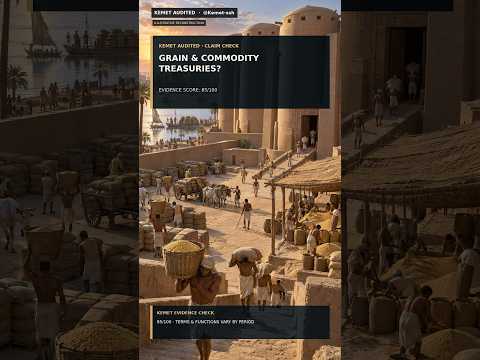
Rows of massive, domed structures rose above the desert landscape, serving as the physical treasury of the state. These granaries were not merely food storage for emergencies; they acted as the central bank of the ancient world. The administration exerted control over these stockpiles to ensure the continuity of state-sponsored projects, from the irrigation works that maintained the land to the monumental architecture that defined the culture. The state functioned as the primary manager of these resources, controlling the supply and regulating how much grain was released into the population. This management was essential because grain, unlike gold, is perishable; the state had to develop systems for proper storage and rotation to ensure the currency remained viable over long periods.
According to Britannica, the pharaonic state utilized these central granaries as a primary mechanism for the distribution of resources. This was a highly organized system of redistribution. By channeling the surplus of the harvest into state control, the government could mobilize resources effectively, ensuring that the work required to maintain the empire could be funded through direct payments of grain to the labor force. The fact that the state held this monopoly suggests that economic stability was largely an extension of administrative oversight. If the state managed the granaries, it managed the movement of labor and the success of the empire’s grand projects. Scholars often infer that this state control served as a hedge against famine, where the state acted as the guarantor of survival in exchange for the population's labor. The direct evidence of large-scale storage facilities confirms that such centralized planning was a cornerstone of their political reach.
Who relied on grain as their only form of compensation?
A peasant, having finished the seasonal harvest, leaves his home to begin months of labor on a temple or a tomb. This laborer was not paid in silver or bronze; instead, he received a standardized ration of grain from the state granaries. This was the mechanism that allowed the pharaonic state to command thousands of people for complex construction tasks without a formal currency system. The reliance on grain as compensation implies a state-level control over the workforce that was both deep and consistent across different regions. This system effectively tied the laborer to the state in a direct economic relationship, where the state was the provider of the means of life.
According to Britannica, the peasants were the largest group in Egyptian society, and their labor was essential to the comfort of the nobility and the pharaonic household. When the state required labor for quarrying stone or constructing infrastructure, the grain held within state granaries provided the sole form of compensation. In this context, the grain was not just a food source—it functioned as a primary economic standard used to sustain the workforce that built an empire. While scholars infer that this system ensured loyalty and sustenance for the laborers, what the evidence directly shows is that without these grain payments, the construction of monumental architecture, which required immense organization and manpower, would have been functionally impossible. The payment in grain allowed the state to circumvent the need for market-based wage competition, as the state effectively dictated the value of labor through the size of the grain rations allocated.
What does the genetic evidence tell us about this ancient commodity?
Small, desiccated seeds recovered from archaeological sites provide a window into the exact commodities the ancient state deemed valuable. By analyzing the biological history of the crops, researchers have gained insight into the stability and movement of this essential currency. Genetic data confirms that the wheat grown and stored by the state was not a static commodity but one deeply embedded in the historical patterns of trade across the region. This suggests that the "value" of grain may have been reinforced by its utility and its reach in trade networks. Genetic sequencing acts as a biological record, proving that the grain was carefully managed for specific characteristics over generations.
According to a UCL report on the sequencing of 3,000-year-old Egyptian wheat, genetic analysis reveals specific types of grain that were utilized during this era. This scientific advancement provides tangible evidence of the primary commodity used in the exchange system. Furthermore, this analysis indicates that grain functioned as a commodity subject to broader historical movements, suggesting that the state’s economic reserve was part of a complex and shifting network of trade and agriculture. While scholars infer that this grain was the standard for all transactions, the genetic evidence confirms that this specific agricultural output was central enough to be carefully maintained and distributed over many centuries. This evidence of consistency suggests the state had a vested interest in the quality and type of grain produced, as the reliability of the system rested upon its predictable nutritional yield.
How has archaeology transformed our view of these records?
A black and white photograph from a 1908 excavation reveals an ancient coffin half-buried in the earth, capturing a moment in the long history of Egyptian archaeology. Sites like the one studied during the Qurna Queen excavation help scholars reconstruct how wealth was maintained and recorded by those in power. As archaeological techniques have evolved from the era of William Matthew Flinders Petrie to modern, high-precision methods, our understanding of these storage sites has become significantly more nuanced. Archaeology does not merely uncover items; it provides the context for how the administration tracked the very resources that kept the economy alive.
Scholars emphasize that the study of burial goods and storage facilities provides the essential archaeological framework for understanding how life and wealth were recorded by the state. These sites are not just repositories for artifacts; they are windows into the administrative reality of ancient Egypt. By examining these contexts, researchers can move past assumptions and see how the state meticulously tracked the resources that supported their civilization. The evidence shows that these storage sites were managed with high care, indicating that the grain within was perceived as a precious asset rather than just a perishable good. This care is evidenced by the structural integrity of the silos and the proximity of granaries to administrative buildings, which implies that economic management was physically integrated with the governance of the state.
Archaeological evidence suggests that the physical storage of grain was the fundamental mechanism for funding the Egyptian state.
What questions remain about this grain-based economy?
While the evidence for a grain-driven state is strong, scholars continue to investigate the fine details of how this system operated in daily life. One major point of debate concerns the unitization of grain. While we know grain served as payment, it remains unclear if there were official, standardized state-issued measures for every transaction across different regions and centuries. The mechanics of a uniform currency are harder to trace than the existence of the grain itself, leading to competing explanations about whether a local merchant used the same measurement as a state tax collector. This uncertainty matters because it determines the level of complexity we attribute to the ancient market; was there a national standard, or was value determined locally through custom and consensus?
A second unknown is the role of supplemental commodities. It remains uncertain to what extent other materials, such as copper or textiles, functioned alongside grain in the daily market economy of those who did not work for the state. While grain was the state’s primary payment method, it is possible that common people used other items to trade for basic necessities in their private lives. Finally, historical research continues to explore how the state adjusted wages during periods of poor harvest or drought. Scholars are currently debating whether these adjustments functioned similarly to modern currency devaluation, but definitive conclusions remain elusive. It is unknown if the pharaonic administration had a consistent policy for these fluctuations, or if they managed them through emergency stockpile distribution. This gap in our knowledge highlights the difficulty of applying modern economic terminology to ancient systems, where survival, religion, and administration were inextricably linked.
Why does this evidence still matter to us today?
Understanding the Egyptian economy challenges the modern tendency to define currency only as portable, metallic, or digital assets. The Egyptian model demonstrates that a functional currency can emerge from the intersection of environmental stability and administrative organization. Because the economy was structurally dependent on the annual Nile flooding to sustain crop yields, the stability of the currency was inextricably linked to the natural cycles of the environment. When the floods were high, the currency was stable; when the floods were low, the economic system faced immense pressure. This linkage shows how the physical environment acts as a constraint on economic growth and demonstrates how ancient states built systems specifically to insulate themselves against the unpredictability of nature.
This history matters because it highlights how different societies have solved the problem of value and exchange. By studying the reliance on grain, we gain a deeper appreciation for how ancient administrations managed risk, labor, and resources on a massive scale. The legacy of these granaries serves as a reminder that the most essential financial reserves in history were often not locked away in vaults, but were sitting in plain sight, waiting to be processed, measured, and distributed to feed a nation. While modern economies rely on abstract, intangible wealth, the Egyptian experience shows that for a civilization to last, it must prioritize the tangible, biological necessity of its people. This reminds us that at the core of every economy, no matter how complex, there remains a fundamental need to manage physical resources to support a functioning society.
What should we look for next in this history?
Future archaeological investigations are likely to focus on the remains of local granary sites to see if the standardization of measures varied between the central state and private individuals. As we continue to refine the use of isotopic analysis and genomic studies on ancient seeds, we may eventually be able to map the movement of grain with even greater precision. These studies will continue to offer a more granular view of how trade and internal exchange functioned outside of state-sponsored construction projects, and whether there were competing methods of valuation across the landscape. The potential for future research to identify variations in grain quality across different time periods could also offer clues into how the state prioritized resources during times of plenty versus times of scarcity.
Researchers are also paying closer attention to the administrative records left behind by scribes, which may hold the key to understanding how wages were calculated in times of scarcity. As new technology allows for less destructive and more targeted excavations, the picture of the Egyptian economy will continue to clarify. Exploring the relationship between the Nile's floodwaters and the state’s grain stores remains one of the most promising avenues for understanding the resilience of this enduring civilization. The focus remains on how these administrative, agricultural, and environmental factors interacted to sustain one of the longest-lasting empires in human history. By piecing together these administrative, environmental, and physical records, we continue to bridge the gap between ancient necessity and modern understanding, revealing how a civilization built its power on the foundation of a harvest.
The stability of Egypt’s grain currency was intrinsically linked to the predictability of the annual Nile flooding.
First published on Kemet (kemet-stories.pages.dev) · reference KMT-5DEA4E
← Back to the archive